The current interconnected business world is pushing the boundaries by entering into untapped markets, hiring resources from across the globe, and handling difficult human resource-related compliances without necessarily having in-house resources. However, expanding and growing the workforce also poses its own problems in terms of taxes, labor compliances, salaries, and employee benefits.
It’s at this point that a global PEO (Professional Employer Organization) can become a valuable partner. They help a company employ and manage their employees around the world without creating entities in other countries. Unlike contractors and recruiters, global PEOs assume vital responsibilities as employers and allow the company to maintain command over the operations.
What is a Global PEO?
Global PEO is short for Professional Employer Organization and refers to an HR and compliance outsourcing firm that assists organizations in employing people in other countries even without having any legal entity in that country. Through the process of co-employment, Global PEO becomes the Employer of Record (EOR), which is responsible for all operational functions like compensation and growth-related activities of the company in question.
A Global PEO enables your business to:
- Recruit employees in new markets faster.
- Remain Compliant with Local Labor Laws.
- Processing pay and benefits packages properly.
- Avoid the time and cost associated with establishing foreign entities.
It can prove very useful for those organizations that are entering global markets or managing global employees.
International PEO vs Local Entity Setup: What’s Better?
When companies enter new nations, there are two choices available for them:
- Formation of a local legal entity
- Using International PEO Services
- Hybrid models across markets
Creating a local entity is also very costly and time-consuming. A global PEO enables you to directly hire employees in foreign markets without creating a local entity. This saves you lots of time and costs while also taking care of compliance.
Typical Use Cases for a Global PEO
Below are ways in which the Global PEO can prove priceless:
Recruitment of Virtual Teams Internationally
PEOs know about different employment laws when recruiting employees in various countries, so it becomes easier to comply with.
Regulated Industry Compliance
Some sectors like banking and healthcare have strict regulations; a PEO will assist in adhering to them.
Payroll Consolidation
Global payroll is complicated. PEOs centralize the payroll function across geographical locations.
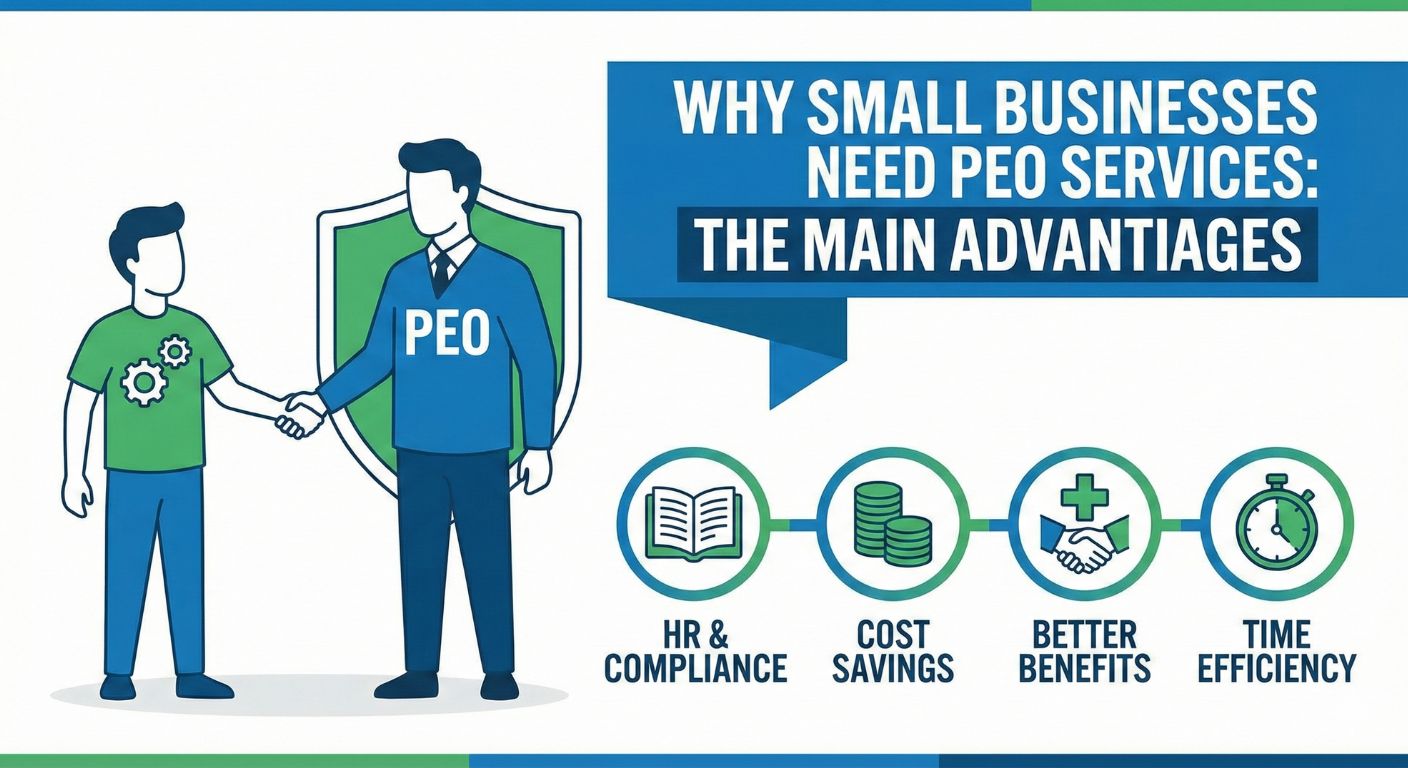
Why Small Businesses Need PEO Services: The Main Advantages
Global PEOs are not limited to large corporations; in fact, they prove to be quite beneficial for small businesses too. The use of PEO services in small businesses is gradually increasing because of their competitive advantage.
- Accelerated Business Growth and Competitive Advantage
Studies indicate that the growth rate of small businesses that partner with a PEO is 7-9% compared to other small businesses that do not. Such growth can be attributed to the effect of outsourcing HR functions.
PEOs provide efficiency, compliance, and organized HR processes, allowing small companies to punch above their weight.
- Cost Savings and Improved Benefits for Employees
Small businesses have difficulty providing competitive health insurance and retirement benefits for their employees. By pooling multiple client companies together, PEOs enable businesses to secure benefits packages available only in much larger enterprises.
This not only aids in attracting the best employees but also boosts employee satisfaction levels.
- Minimized Administrative and Legal Load
The management of payroll taxes, labor laws, workers’ comp, and human resources issues can be a burden for small businesses. The major advantage of using a PEO is that it can handle all the previously mentioned issues.
- Enhanced HR Services
Without Having a Human Resources Department In companies that do not have a complete HR staff, PEOs bring trained HR professionals who oversee:
- Onboarding
- Accuracy of payroll processing
- Benefits administration
- Compliance reporting
It assists small businesses to be like big businesses in the way the latter function despite limited budgets.
- Improved Compliance and Reduced Risk
PEOs keep up with constantly changing employment laws like overtime regulations, taxes, etc. This could help save businesses from fines and lawsuits. In some studies, it is found that 95% of employers whose services PEO provided have shown improvement in complying with regulations.
Global PEO versus Employer of Record – What’s the Difference?
Though both models assist in global recruitment, the difference is:
PEO is normally used by businesses without local entities in cases where they require complete human resources support.
EOR definitely involves pure employment coordination without the element of co-employment. Read more – What’s the Difference Between PEO and EOR Services for H-1B Hiring?
These days, providers are incorporating hybrid PEO and EOR solutions in order to maximize flexibility.
PEO vs. Alternatives: HRO, EOR, In-House
| Feature | PEO | HRO | EOR | In-House |
| Co-Employment | Yes | No | Yes (Intl) | N/A |
| Benefits Access | Large-group rates | Limited | Country-specific | Small-group |
| Liability Sharing | Full HR | Admin only | Global compliance | Owner bears all |
| Cost Savings | 20-27% | 10-15% | High for intl | None |
| Best For | US SMBs | Basic outsourcing | Global hiring | <10 employees |
PEOs excel domestically; pair with EORs for full international professional employer organization coverage.
How Does a Global PEO Work?
Through co-employment, the PEO becomes the Employer of Record (EOR) which handles legal employment while you retain control over strategy, culture, and daily operations.
Understanding how Global PEOs work explains the quite apparent reasons they are useful:
Partnership Arrangement- Your company signs a service agreement with a Global PEO.
Co-employment onboarding- For the purpose of payroll and compliance, the PEO turns into an Employer of Record.
Payroll and Benefits Implementation- Through a PEO system, workers are paid, and centrally, benefits are administered. Read more about The Role of a Global Professional Employer Organization in Managing International Payroll
Continuous Compliance and Reporting- The PEO delivers local compliance on tax and labor as regulations change.
Integration with Existing Tools- Many Global PEOs integrate with HR technologies, payroll software, and collaboration platforms for a seamless experience.
Your Company → Global PEO → Local Employee
↳ You: Hiring/Firing/Day-to-Day Operations, etc.
↳ PEO: Payroll/Taxes/Compliance/Benefits, etc.
The 7-Step Global Hiring Process
Step 1: Country Selection
Evaluate market readiness in over 185 countries:
Green Light (24 Hours): US, UK, Canada, Australia
Yellow Light (3 days): EU, Brazil, India
Red Light (7+ Days): China, Russia
Primary factors: Labor laws, taxation treaties, talent pool.
Step 2: Local Compliance Blueprint
The standards differ for different countries. For instance, consider the following example-
Country Key Requirements
Brazil FGTS (8% severance),
Germany Unlimited sick leave, 30+ days of
India Provident Fund (12%
UAE End of service gratuity
Output– Prepared ready-to-use employee handbook in local language.
Step 3: Benefits Benchmarking
The Global PEOs take advantage of group rates. Local Rates of Return Compared with PEO Group Rates (Average):
Germany: €650 → €520 (-20%)
Brazil: R$2,800 → R$2,100 (-25%)
India: ₹18K → ₹14K (-22%)
Portable benefits mean that these benefits are taken abroad by expats.
Step 4: Compliant Contracts
To frame an agreement regarding the following:
- Local Termination Rules
- IP Ownership (It should be 100% yours)
- Non-compete (where enforceable)
- Over 40 language versions
Digital signatures facilitate moving forward.
- Unified Global Payroll (Weekly)
Single dashboard for multi-currency payments:
Sample Payroll View: Brazil R$ 6,200 (FGTS deducted)
Germany: 4,800 (social security returned)
India: ₹85,000 (PF + taxes paid)
PEO manages: Local withholding, currency conversions, year-end filings.
Step 6: Global HR Platform (Always On)
Centralized system with auto-localized rules: The Employee Self-Service Portal:
- PTO (local entitlements auto-applied)
- Performance reviews (custom templates)
- Expenses (country-specific regulations)
Step 7: Graceful Offboarding
Established exit procedures include:
- Local notice period
- Auto-computed severance
- Final payroll and tax clearance
- Compliance Documentation
Why Do Global PEOs Grow Better Compared to Subsidiaries?
- It eliminates the need for $50K+ entity formation.
- You don’t have to pay compliance fines as the PEO assumes responsibility.
- It offers a single contract instead of multi-country legal teams.
- It covers all the benefits given by local companies.
Country Coverage Comparison:
Global PEOs: 185+ countries
Local Entities: 1 Country
Bottom Line: Global PEOs change ‘international expansion’ from a 2-year nightmare turns into a 21-day execution, offering PEO small business opportunities globally without boundaries.
Costs and ROI of PEOs: Unlocking Hidden Savings for Small Businesses
It’s easy to look at the upfront costs and deem PEOs as expensive, but once we analyze the cost and ROI breakdown, everything makes sense. The benefits outweigh their costs any day.
PEO fees generally range from $50-150 per employee per month or 3-6% of total payroll, but where the rubber really meets the road is in the return on investment-
- Often 7-10 times through slashed HR costs,
- Premium benefits at group rates, and
- Compliance shields that avoid expensive fines.
For small businesses, in particular, these benefits compound with time, turning fixed overhead into a multiplier of revenue as you scale.
PEO Pricing Models Simplified
Two ways of paying:
Fixed: $50-150/employee/month
It’s perfect for predictable headcounts. What you see is what you get-
- Payroll % (3-6%)
- Flexes with seasonal hiring or overtime
- Great for retail, hospitality, construction
Global add-ons? Only 1-2% more for international payroll via international professional employer organization services.
Savings that might not be directly visible:
- Free workers’ comp audits
- 401(k) set up at no extra cost
- 20-27% benefits discounts = $1,500/employee/year saved
If we compare this to in-house HR. It costs $60K+ annually per employee. That’s why PEOs always win.
Wow ROI Numbers
According to NAPEO, PEO clients achieve:
+10-14% revenue growth
+16% higher profits
-12-14% turnover
-27% HR admin time
ROI Example: A 50-Employee Firm’s Transformation
Consider a 50-employee mid-sized tech consulting firm, with an average salary of $60,000 ($3 million a year).
| Cost Category | In-House Annual | PEO Annual | Savings |
| Benefits Admin | $150K | $100K | $50K |
| HR Overhead | $100K | $30K | $70K |
| Workers’ Comp | $50K | $25K | $25K |
| PEO Fee | $0 | $120K | Net +$75K |
| Growth Boost | Baseline | +10% Revenue | $300K+ |
Total ROI? Over 7x in year one, scaling exponentially.
How to Choose a PEO: Buyer’s Checklist
Choosing the right Global PEO is a strategic decision. Consider these key criteria:
- Coverage by Country
Make sure that the supported countries of the PEO are the ones in which you want to hire.
- Compliance Knowledge
Look for PEOs with demonstrated knowledge of local employment law and regulatory requirements.
- Benefits and Payroll Services
Compare offerings, everything from health insurance to retirement plans, to ensure the options meet the needs of the business.
- Integration Capabilities
This is the reason it’s very important to make sure that the PEO will fit in with your company’s current HR systems and workflows.
- Security & Data Policies
Ensure robust protection of data, privacy policy, and compliance with the international standards.
- Price Transparency
- Price Transparency Understand fee structures (by employee, percentage of payroll, flat rate), so that there are no surprises.
Pros and Cons: Global PEO Overview
Pros
- Fast expansion into new markets
- Support of compliance
- Eligibility to benefit from corporate rights
- Lower HR Overhead Costs
Drawbacks
- Reoccurring service charges
- The Complexity of Co-Employment Relations
- Different exit procedures of each supplier can create confusion if not understood thoroughly.
What Small Businesses Need to Know Before Entering a PEO Agreement?
Before You Finally Lock in a PEO:
- Analyze the impact of co-employment.
- Understand the obligations concerning payroll.
- Provide a definition of “data protection,” and then define what
- Seek details about termination or exit fees.
Conclusion
In this world where talent has no boundary, and the complexity of global compliance is rising every day, Global PEOs have come from being a niche HR offering to being an integral growth partner itself. Knowledge of how to choose PEO and strength of PEO for small businesses can be your steppingstones.
Through the delegation of all your HR, payroll, and compliance matters to your chosen PEO partner, your organization can gain agility, competitiveness, and expansion.
Global PEO FAQs: Top Questions Answered
Here are the most frequently asked questions about global PEOs and PEO small business benefits, based on common searches and industry patterns from your pillar content.
- What is the difference between a PEO and a global PEO?
A typical PEO involves co-employment for domestic HR/payroll/benefits administration while the Global PEO provides this service for 185+ countries as the Employer of Record, with country compliance without the need for entity incorporation.
- How Much Does a Global PEO Cost?
Typically, $299-599 per employee/month all-in, for payroll, taxes, benefits, & compliance. Vs. $100K+ for local subsidiaries. Country risks & services determine prices.
- Will I lose control of my workers with a global PEO?
No. You will maintain control over all employee hiring and termination, daily business operations, employee performance evaluations, and company culture as you do currently. The PEO’s role will simply be to fulfill all legal and compliance related requirements.
- How quickly can I hire internationally with a PEO?
14-21 days from job post to Day 1, in contrast with 6-12 months to form an entity. Green-light countries (US & UK) 24 hours.
- Whathappens if I need to terminate an international employee?
It deals with the notice periods, calculations for termination benefits, final salaries, as well as tax clearance. This only involves the approval of the action.
- How do I switch from my current setup to a global PEO?
Migrate in 4-6 weeks: Audit → Contract → Data import → Employee notification → Go live. Synchronize with minimal disruption for mock payroll processing.